Showing posts with label Where Ive Been. Show all posts

06 March 2013

A Beginner's Guide to Girdles: Belts in the 16th Century (X-post from Ren Artisan)

This was originally posted at the Renaissance Artisan Project my year-long (sic) project to explore all the crafts of the Elizabethan period. There are plenty more like it. In recent weeks we've made pins, explored two kinds of beer mug, and learned to knit.

54 Livery Companies representing 111 crafts in 52 weeks! What could possibly go wrong?
(Narrator: It would all go very wrong, but in an interesting way...)
~ Scott

-------
I've been to many renaissance faires and acted in quite a few, so I
don't walk around with a clipboard, taking note of the inaccuracies. That would be boring and boorish. Nonetheless, I think the one I find the most vexing for me (because it would be the easiest one to fix) has to be the Big Errol Flynn Pirate Belts I see walking around with people attached to them.

Belts in the 16th century just were not that wide. And the buckles are almost always all wrong to boot. I look at a lot of old artwork, delving into the sketchbooks of the artists when they're available, and nowhere do I see those big belts. And the metal-detector finds back me up on this one. The buckles we find just simply aren't that big. On average, buckles of the period seem made to fit a 1/2 - 3/4 inch strap.

I can't help noticing these things. It's a curse.

It's important to note that in this time period, belts weren't for holding your pants up. That's a relatively recent development, actually. Belts were there to hold your knife, sword, and/or purse and not much else. (The "I have everything I own tied to my belt" thing at renaissance faires also bugs the crap out of me, but I digress.) In the 16th century, your pants were tied either to the waistcoat or doublet with cords, called "points". In order to take your pants down, you had to take off your doublet or untie your points.

And before you ask: Yes, methods for disrobing and going to the bathroom are a common topic of conversation for male reenactors.

A properly-sized belt worn above a row of bows where the man's lower garments are joined to his upper garments. 

Take a good look at Robert Dudley at the top of this post. He was Queen Elizabeth's favorite throughout most of his life. The very image of mid-reign manliness at the height of Elizabethan fashion. See his sword belt? It's maybe 3/4 inch wide at best. Probably less.

I only bring this up because it's a pet peeve (and you thought I only had pet cats) and because when we do these projects, it's important that we're replicating items as they actually were, not as Hollywood depicts them.

Of Buckles & Leather

The straps I use are generally 5/8 inch. Even this might be a bit wide. These original Tudor buckles from metal detector finds that are being made available for sale from UK website Crossman Crafts are affixed to 12 mm (1/2 inch) straps: http://www.crossmancrafts.co.uk/salvage/

Yes those are real Tudor artifacts. Buckles are so abundant in the finds and so often made of base metals that they're rarely rated as "treasure" in the legal sense, so they can be and often are sold and exported. Aside from the obvious auction sites you can buy original pieces several places online. I like Crossman mostly because the site owner is a craftsman after my own heart and quite generous with his advice to other craftspeople. There's also Gaukler Medieval, which offers a small and ever-changing trove of original items, including artifacts of various periods: http://medievalwares.com/index.php?main_page=index&cPath=65&zenid=2mo9kdrnt8333hk2una5ghv6p1

Of course you can't ever really own a piece of history, but you sure can rent one for awhile.

Note that the real buckles don't look like most of the ones you see at the stores or in movies. The most prevalent in our period are what's known as a 'spectacle' buckle. Meaning they have two rings, and kinda look like a wee pair of glasses. They were made by casting in bronze and brass and/or various precious metals as suited the man or woman that ordered it.

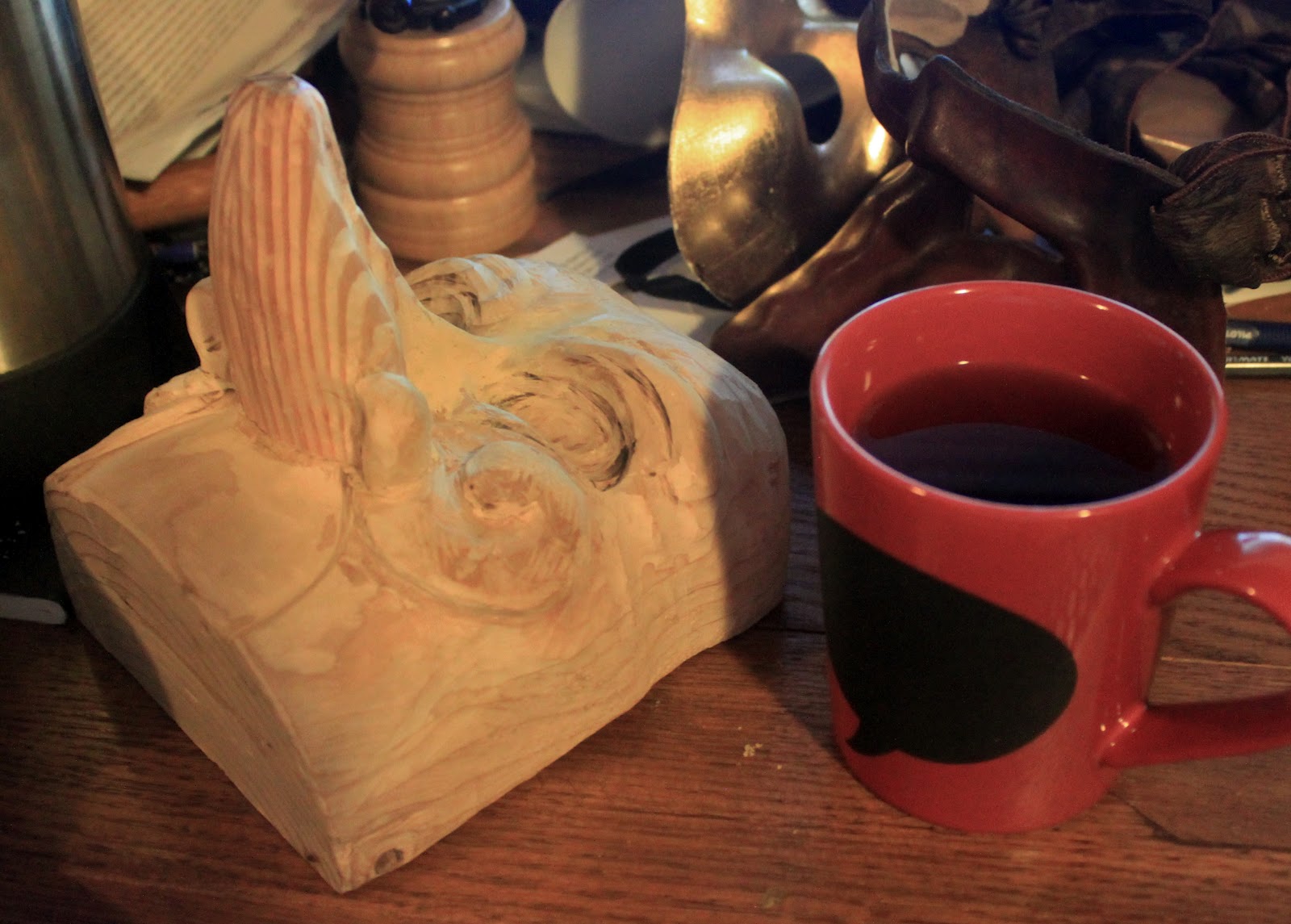
At some point, we have to do some casting. The Goldsmiths, Pewterers and Founders companies lie ahead, of course, and that's what the soapstone in this picture is destined for. Casting projects will likely include buckles because they're an item that one always seems to need, as well as buttons and maybe some silly oddments like pilgrim's badges.

All that lies ahead of us, though, because the Girdler would have probably bought them or had them made special to his specifications by someone from one of those other specialties, then assembled them in his shop. If nothing else, the simple brass ones we're working with here wouldn't have been made much fuss over because they were for the more common folk such as your this humble craftsman whose hands you see here.

I think that I have a burr about belts because they're a very simple project. My first ever leather working project was a belt. I think I was ten. Even before that, my exposure to leatherworking was mostly my dad or grandpa punching extra holes in my belt to keep my jeans from slipping over my scrawny hips.

The Girdler's company did more than make average leather belts like these. They made fine girdles for ladies and sword belts for gentlemen. This sort of thing would be relegated to an apprentice, I should think. All the same, it's an important piece of kit.

For a simple, leather belt, there's only two pieces to worry about: A belt and a buckle.
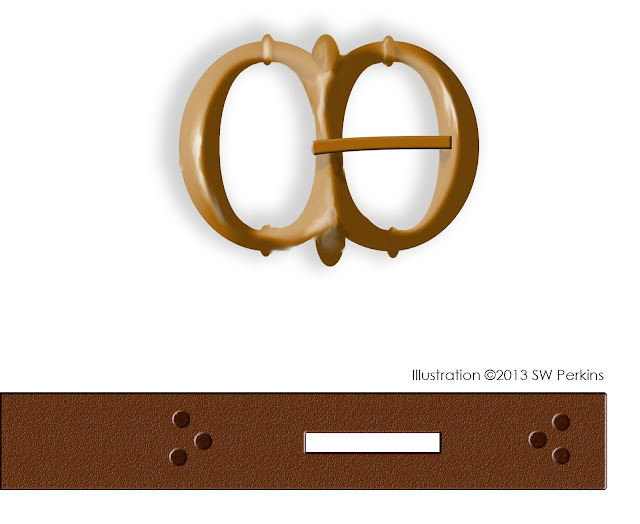

It goes like this: 

  1. Order your buckle and cut an appropriately-sized strap (or buy one at a leather working supplier like I usually do. Unless you buy your leather wholesale, the savings of cutting your own straps just doesn't pan out like you'd think it should.) 
  2. Cut a slot near one end of your strap to accommodate the tongue of the buckle. 
  3. The buckle slips on, with the tongue passing through the slot and given enough room to travel by adjusting the length of your slot. You might have to fiddle with it a bit. 
  4. Sew the buckle in place. I like sewing a little triangle as you can see, but there are plenty of other methods. 


NOTE: Don't use pop rivets. They're convenient and I confess to having used them a lot before I learned better. Pop rivets are never really necessary and never look quite right. If you want rivets, go to your local hardware store and buy some proper ones and learn how to peen them properly.
Honestly, sewing is much easier. Just punch the holes ahead of time and wax your thread like we did with the leather jack we made the other day.

Now, you might be saying "This article is incomplete" and you would be correct. The simple leather belt was the least of the Girdler's wares. Sword belts and fancy adornments for Milady's waist were the heights of their trade, but we're working on the lives of the commonfolk here at the School of the Renaissance Artisan.

Not that I wouldn't like to see input from some of the great craftspeople I know who specialize in those other areas.

Much like the pins we began this journey contemplating, what this simple leather belt gives us is a jumping off point for further explorations into the craft of those who cast the bronze and brass buckles, the craftspeople who tanned and sold the hides, and so on. This humble belt, assembled by a Girdler's apprentice, sits at the end of a long chain of suppliers, all of whom stand between us and the culmination of this project come December.

For the moment, though, revel in your perfectly period Elizabethan leather belt to gird you against a chaotic world.
~ Scott

22 July 2012

Leather mask making: Sculpting with reluctant media


Real woodcarvers wear pink. (ahem)

The trouble with being on the road so much recently is that you can't take things like masks and wood with you. On the road, it's handsewing; at home, it's all about the carpentry. So I've been clearing a backlog of masks that I promised to folk, which means a lot of carving and a boatload of forcing leather to do things it doesn't want to do.

This is why I often call myself a sculptor of reluctant media. Between the wood and the leather, my hands are full just discovering the way they want to go and then trying to get them to go there.

This is starting to look like a leatherworking blog rather than a broad-scale costuming blog and for that I apologise to anyone who doesn't want me to dwell on wood and leather and would like to see a bit more cloth. I'll get back to cloth soon. I promise. In the meantime, here's some more leather mask making.

If you are new or looking for instructions on how to make commedia dell arte masks, or just leather masks in general, you will find a tutorial here that gives you the basics of the craft. Yes, the craft. The art of the thing is up to you to bring to the table.

Try as I might, there's only so much of this that can be taught in a blog format.


I mentioned the horn mallet in passing in my demo on the tiny mask. They're kind of a pain
to make, but no one sells them, so make them you must if you want one. "Drill hole, epoxy
handle into place" is a deceptively simple set of instructions. A lot of fussing and cussing is
involved. Most of the other tools used to do this thing can be purchased anywhere that clay
tools are sold. Assuming you don't want to make those too.


The horn mallet not only helps shape it by forcing it down into the grooves and valleys of the matrix, it also compresses the leather, stiffening the mask. The dimples can be smoothed out or left as a texture. I like leaving the dimples around the periphery of the mask and sometimes in the valleys. Texture helps those areas recede visually. (Domino-style minimum coverage zanni mask, commissioned.)


These masks are notoriously difficult to photograph. Note how the dimpled texture helps define the high points from the low. Combined with the shading provided by an careful application of the dye, the mask takes on additional dimension and character. The nose seam on this one was a bit of pain. (Domino-style minimum coverage zanni mask, commissioned.)


I just love this color. The challenge here was making a mask that was non-threatening and cheerful. Most zanni masks tend to look a bit maniacal under the best of conditions by design. Raised brows and wide-open eyes are part of the recipe. I also borrowed the Arlechinno spiral cheeks (which I'm told was historically meant to indicate a handlebar mustache -- automatically awesome).


The trick to pulling off a large full-coverage nose like this one is the inevitable seam where your leather wraps around the nose. I've heard it described in a dozen places, but really this is one of those things that you have to figure out for yourself. This is where craftsmanship is king.


Mask matrices can be re-crafted a couple of times. For a one-off commissioned piece, I'll use the matrix in its original form only that one time. This one has had the nose shortened and re-positioned and cherubic cheeks added using wood putty. Recycling is good.


When I retire mask matrices as I have these two, I usually put a hanger on the back and hang them up on the wall, which is the fate that these two are currently awaiting. 

26 May 2012

Making Leather Commedia Dell Arte mask - Tutorial and Demo

In case you ever wonder about why I take so long to complete some of these projects, I'm always working on something, even if I'm not blogging about it. I've been working on commissioned masks in the commedia style.  I'm not going to turn this into a maskmaking blog, but I did a tutorial series awhile back on making a miniature version of my favorite mask.

Maskmaker, Maskmaker, Make Me a Mask

Part One: Planning & Carving
Part Two: Carving & Completing the Matrix
Part Three: Prepping the Leather (Skivving Tutorial)
Part Four: Molding the Mask (Wetforming Leather)
Part Five: Finishing the mask

Now if you will please excuse me, I've miles to go before I sleep...


28 March 2012

Idle Hands...


Idle hands, my mother has often assured me, are the devil's playground. I have to assume that she knows from observing someone else, because I've never known hers to be idle, so it cannot be from personal experience.

These are my mother's hands, photographed the day after her surgery for breast cancer.

It was one of the few idle moments she had and the only day she really spent resting... at least by my definition of the word. Before I knew it, she was inviting relatives over and cooking a turkey dinner.

These are not idle hands -- these are fighting hands.

It was a strange learning experience for all of us, I think. There are not many moments in your life that you can point to and say "This is a point where this changed" but this was one of those moments. Mom is an ace at not being idle and has a genuine knack for keeping her son's hands from being idle either...
Pro Tip: Before you volunteer to help someone out after surgery, first find out whether they have a deck that needs to be stained and plan (or at least pack) accordingly.
That week, I discovered that I could help clean and dress wounds without fainting (my condolences to everyone who lost money in the betting pool). Yes, I stained a deck, and I also discovered that radiation suites often don't get decent WiFi. I also awarded an honorary Nobel prize for awesomeness to the innovator that brought us the hotel lobby espresso stand. I also handmade a couple of doublets, which I'll give their own posts.

I am happy to say that my mom did well. I was able to return home just in time for my 12th wedding anniversary. The universe gave us the gift of a broken hot water heater. 

We decided that the water heater was officially a piece of modernist sculpture (since art has no function, I couldn't feel bad that it wouldn't heat my water). We mopped the floor, turned off the power and water to the stupid thing and went out to spend the day on the town. We bought each other a bag of books and I gave Kris a lovely cross to wear with this year's renaissance gown. 

12 years ago I said "I do" to a lovely lady who kindly agreed that she would too. You think a bit of malfunctioning junk like a hot water heater can touch that?

Life happens. Sometimes it seems to happen all at once and sometimes it stops happening before we're ready. Hug the people you love. Tell your friends how you feel about them. Because you never know when you will quite suddenly lose the chance to do so. 

Also, please talk to the women in your life, tell them you care. Ask them when their last exam was. Make the appointment. Go with them if you have to. Give the gift of life and health: encourage yearly mammograms and for all women to have a baseline scan at 35.

Women's health is not a women's issue -- it is a human issue. We seem to be a society that is locked in a perpetual state of forgetting that one person's fight is everyone's fight. We may be two genders, but we are one species. That's what it really means to be a nation. We're supposed to have everyone's back because we know everyone has ours. 

E pluribus unum -- from the many, one. I've got your back because I know you've got mine. We're in this together.

How different our world would be if we could just cling to that one simple truth.

-Scott

25 July 2011

The Clown and the Toymaker :: Exit stage left, pursued by bear.

As I mentioned, I've been having back problems. Between May 5th and July 3rd, my spine went into meltdown until I was walking with a cane. Since then, the cane and the pain both went away, but it was an eye-opening experience.

I can no longer keep up the level of physicality that my role as fool requires of me.  Or -- more to the point -- that I require of me. I cannot meet my own standards and that means it's time to hang up the mask.


This year, my fool will play his usual role of Master of Ceremonies atop the castle gate for the opening ceremonies at the Washington Midsummer's Renaissance Faire, but that will be it for me.  

Next year, Calabash the fool will be retired completely.

That is not to say I'm going anywhere, but I just can't caper like I used to or rely on my body to carry me through the run of a faire without crapping out on me.

In the immortal words of William Shakespeare, "Exit stage left, pursued by bear."

What's next?

I needed something to allow me to keep doing the stuff I love, but also to take my time about it. To be able to entertain and interact as I always have, but at a rate and level that will accept whatever is happening to me at that moment. And I also wanted the flexibility to take my inner Davinci out and take him for a walk.

I toyed with the idea of doing a potter or carpenter/joiner sort of thing, but those involved hauling too much crap out of the faire every weekend. But I still wanted to do something artistic, or at least artisinal. Something that incorporated all the stuff I really love to do...

Enter the Village Toymaker.

Forget Davinci, I'm about to let my inner Jim Henson out to play.


How it impacts this blog...

This is to your benefit, dear reader, because this blog is about to get active again. The next series of posts (beginning with the long-promised leather-working tutorials, I promise) will be about creating the toys and oddments that will sell the role of toymaker to the crowds.

I need to make shoes, toy drums, little leather masks, and a boatload of period encampment stuff that I've never really worried about because Calabash was a mobile character. He didn't need a work table, a leather bottel, or a marionette...

Well, maybe the marionette.

So coming soon will be costuming for me and for dolls. (Shoemaking post coming soon!) Discussions of period toys, marionettes, and the clothing of the merchant and artisan class of the renaissance.

I hope you will join me.

Scott

27 August 2009

Role to Hit

I'm working on two new articles for Garb for Guys, which will be put up as soon as a couple of photographs are fixed and/or re-shot.

In the meantime, if you're feeling bookish and/or if you're looking for me and I'm not here, you can find me at my writing blog,
Pages to Type Before I Sleep... I keep an (almost) daily journal where I comment on writing, books, literary culture and the busy intersection of books & technology... the sort of things that might distract me from the book I'm writing if I let them fester. Below is a sample of what that looks like:


Role to Hit
Cross-Pollination Part IV - Lessons Novelists Can Learn from Other Storytellers


I learned to tell stories from my dad, who was quite the raconteur when the mood struck him. I learned to love stories by reading a lot of them. I learned about characterization and what made a story drag you to the edge of your chair by participating in them.

As if I haven't already made it clear that I'm a nerd, today I shall remove any lingering doubts. Today we're going to talk about... (deep breath) role-playing games.

I'm sure I have a pocket protector around here somewhere.

A table in a basement surrounded by young men, soda cans and empty pizza boxes. This raucous gathering was sterotypically the smarter kids from their school who found common cause in their esoterica. Mostly young men, they gather to breathe life back into a faded mythos governed by obscure rules and the chance roll of polyhedral dice... role playing games. About the only legal activity in the high schools of America circa 1980 that had any air of mystery about it. Movies and news reports tried to link role playing games to all sorts of satanic pseudo-mystical nonsense while most of the players viewed it in much the same way their fathers viewed Friday night poker games.

Most people know about Dungeons & Dragons, but there were far more than that: Top Secret, Vampire the Masquerade, Ninjas & Super Spies, Shadowrun, Battletech... the list seems virtually endless and at one time or another and I played them all.

What does this have to do with storytelling?

Everything and nothing.

It's axiomatic that the story looks different from the inside than it will look from the outside. I can tell you stories about things that really happened to me in the back-country during my mountaineering and backpacking days and make you laugh every time. Stories that were frightening, uncomfortable and dangerous when I was living them. I can tell you stories about bad guys thwarted, secret plans stolen and dragons slain in imaginary games and get much the same reaction. But in neither case - the real or the imagined - will it be the same for your reader if you re-tell my story to someone else. It's inherently different because I was there. I was standing in front of that bear or staring over that ledge or slaying that imaginary dragon.

The dramatic tension comes from the experience. The story would not be the same had I not subjected myself to the whims of chance, the roll of the die. And since you didn't experience it except through my narrative, you will tell it differently and with less immediacy than I.

That isn't to say that I want you to run out and throw yourself in front of a bear, or get buried in an avalanche. You don't need to do that in order to write about them. Nor do you need to put together a role-playing game based upon the novel you're writing.

Roleplaying games taught me to have an experience that didn't really happen, to watch it unfold through the eyes of a fictional character. Even if I didn't know what it felt like first-hand to stare down the snout of a black bear or free fall into nothing on the end of a bungee cord, I could create a semblence of that experiencve because I've learned the skill of putting myself into the head of a person that does not exist.

In Telling Lies for Fun & Profit, Lawrence Block talks about how finite even the most compelling life is in terms of storytelling potential. Even if you lived a life of danger as an international jewel thief, you are still - as Block puts it - sitting on a raft in cold waters, chopping bits off the back-end to feed the fire you've started at the front. At some point you will run out of boat. Being able to live through the eyes of an imaginary person allows me to build a bigger boat, feeding the fires with imaginary planks.

One last thing about lessons role-playing games can teach us and then I'll shut up about them...

In Across the Crowded Marketplace, I dwelt on the definitive archetypes, the roles your characters play in the stories they inhabit and how important it is that your readers be able to recognize them on a cultural level. At the core of that is a crucial understanding of your character and what role they fill in the story.

Part of this is the ability to play them consistently through the entire story. On page ten one ear is lower than the other, than on page 220, those ears had better still be assymetrical. I keep track of this using something else role-playing games taught me... the character sheet. Height, weight, eye color, hair color, ethnicity, skin tone, education, distinguishing features, idiosyncrocies... all on an easy-to-reference sheet of paper. This sounds fussy and even anal, and I suppose that it is. It also keeps my legendary absent-mindedness from sidelining my writing while i search the manuscript for some tiny detail from the first chapter.

Role-playing games take place in worlds that are fully-realized entities apart from ours, a shared landscape of the imagination replete with maps, politics and adventures in the offing. they are a place where we can step into other skins and other lives. A similarly-realized world should unfold each time I open my laptop and type "Chapter One" at the top of a page. I owe it to my world and to my characters to know them well enough to be able to tell their stories as if I'd been there too.

---


Scott Walker Perkins writes literary thrillers and novels of suspense woven from the threads of history. His current novel is The Palimpsest and he is working on another tentatively titled 42 Lines.

Contact Me:
swalkerperkins@gmail.com

Contact Me LinkedinFacebookBloggerTwitter

14 July 2009

The blog has been idle, but I have not...

A lot has happened since last we met. I lost my father to cancer, which set me back quite a bit and threw just about everything into a cocked hat. Add to the fact that about nine months before he passed away, I was in a car accident and you get a bad year all the way around.

Nevertheless, I've found my bearings and come through. I hope you stuck with me through the long silence.

These are the things I've been up to recently...

I've been learning to mold and sculpt with leather. Allowing me to make some leather masks for dear friends and loved-ones for to conceal their identities mid-foolery:


Which is known far and wide as "The Bubble Mask" (bubbleblowing mechanism designed by my fair ladyfool, pictured). You can see Daf's Bubble Mask in action in the parade video at the bottom of this post.

They're getting more elaborate as I go along and experiment with the extremes of the leathern medium. I'm planning to play with the forms quite a bit. The forms will be historically inspired as any leather mask must be, but as you can see, I have my own take on things. The red and green masks, for instance, are quite goblinish. I'll post more as I make them.

I also made a snazzy new hats. When I'm feeling down I often start making hats. This hat is a pattern entirely my own and is quasi-period inspired. There's a "cockscomb" of bells down the centerline and the "ass's ears" are unabashedly curlicue (they're wired so I can move them around and they'll stay where I put them).

It isn't necessarily meant to be 100% accurate so much as draw attention when I'm promoting the faire at parades and the like.

I completed the suit of clothes I've been talking about and will post details on that soon. I hope to revive this blog in the near term with details and updates as I document that suit of duds and begin construction on my very period suit of noble silks.

I've also written another novel, painted my house, performed a wedding and started another blog specifically dealing with the things that occur to me about and while writing that updates at least three times a week if not more often.

This is our renfaire's participation in the annual Gig Harbor Maritime Festival parade... "Pirates of the Peninsula" was the theme of the event. You can see my new hat and Daf's bubble mask in action throughout the video.